Is Traditional SEO Dead? SEO vs GEO vs AEO Explained for US Businesses
Traditional SEO is not dead. People still use search engines to find services, compare products, and solve problems. What is changing is the way some search results present information, including AI-generated answers that link to websites.
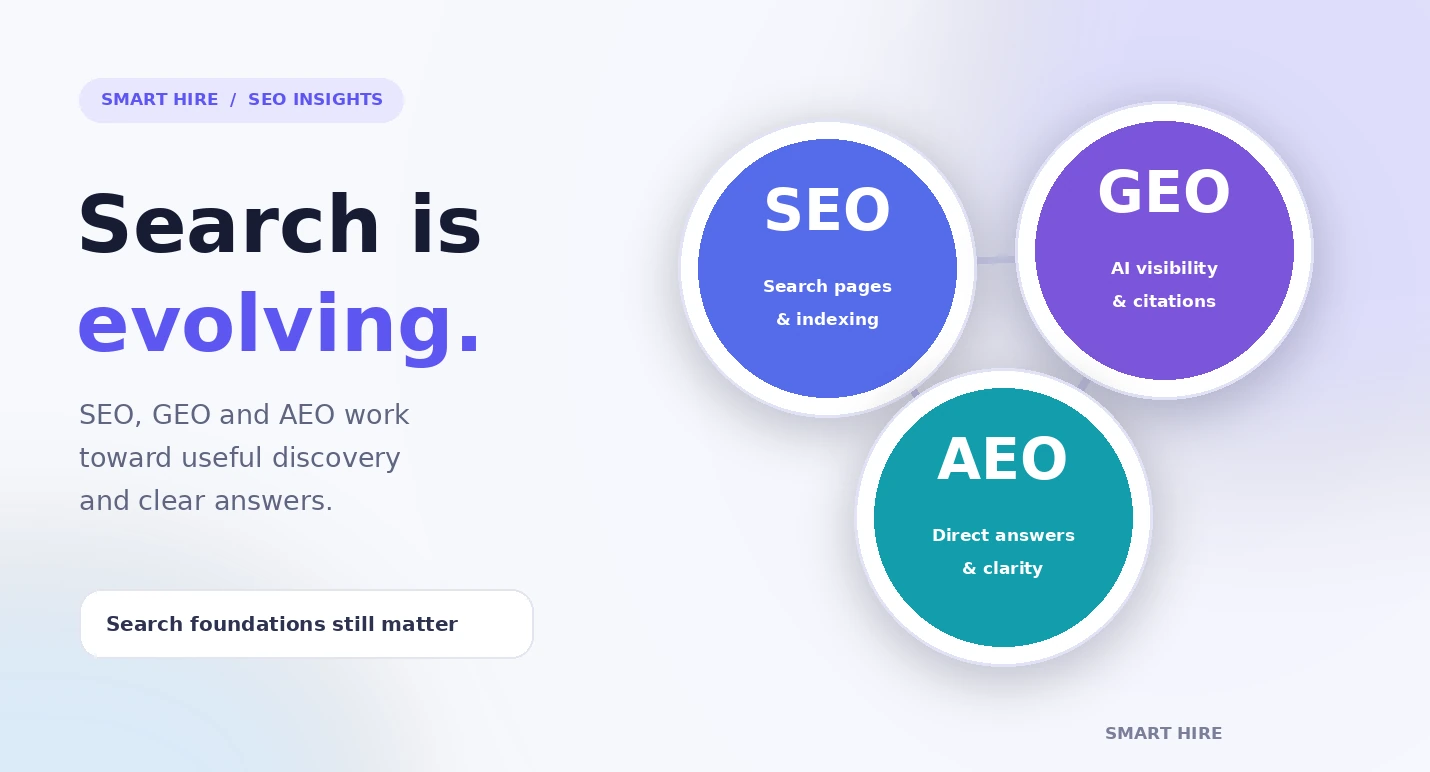
That is why you may hear three terms: SEO, GEO, and AEO. Understanding SEO vs GEO vs AEO starts with what each term means. They describe related ways of helping people and search systems find useful information, but the terms are not used in exactly the same way by every marketer. For most US businesses, the practical starting point is still a well-built website with helpful content, clear service information, and sound technical SEO.
Google’s current guidance for AI features in Search says the usual SEO best practices remain relevant. It does not require a separate set of special optimizations to appear in AI Overviews or AI Mode.
What Is SEO?
SEO stands for search engine optimization. It means improving your website so search engines can find, understand, and show your pages when people search for something relevant.
For example, a dentist in Columbus, Ohio, may want to appear when nearby residents search for family dentistry, dental implants, or emergency dental care. Useful service pages, accurate business details, fast mobile pages, relevant local information, and links between related pages can all support that goal.
SEO does not mean repeating a phrase hundreds of times. It means helping people find the right page and giving them a good reason to use it.
What Is GEO?
GEO usually stands for generative engine optimization. In marketing, it often means improving the chance that your business or content is mentioned or cited in answers created by AI tools.
The term is still used in different ways. Some people focus on Google AI Overviews, while others include AI assistants and other answer tools. Because the label is not applied consistently, ask any agency what it means in practice and how it will measure the work.
The useful work is not a hidden trick. It includes publishing information that adds something new, explaining services clearly, showing real experience, and making sure the website can be found and understood.
What Is AEO?
AEO stands for answer engine optimization. It usually refers to making content easier to use in direct answers, such as a short explanation, a featured snippet, or an answer shown by a search tool.
For example, a payroll company could publish a clear guide that explains the difference between an employee and an independent contractor. The page should explain the question in plain English, point out where situations can differ, and link to the right official source when it discusses rules.
AEO overlaps with SEO and GEO. It is best treated as a way to think about the questions people ask, not as a separate technical system that replaces SEO.
SEO vs GEO vs AEO: What Is the Difference?
The simplest way to separate the terms is to look at the goal.
- SEO helps your pages get discovered and understood in regular search results.
- GEO focuses on helping your useful information become visible in answers made by generative AI systems.
- AEO focuses on presenting clear answers to specific questions people ask search engines and answer tools.
The methods overlap. A page that gives a clear answer, includes original information, and works well technically can support more than one of these goals. You do not need three unrelated content programs to cover them.
What Google Says About SEO for AI Search
In May 2026, Google Search Central published a resource to help site owners understand AI features in Search. The article also addresses common misconceptions about AEO and GEO. Its main message is that the foundations of SEO still matter, and content should provide information people cannot get from dozens of nearly identical pages.
That means businesses should be careful about offers that promise guaranteed placement in AI answers, special markup that supposedly forces a citation, or a fixed number of AI mentions each month. No outside agency can control which answer Google or another AI system chooses to show.
Read the Google Search Central article about optimizing for generative AI before paying for a service built around claims that go beyond Google’s published guidance.
What US Businesses Should Do Now
1. Answer real customer questions
Talk to your sales and support teams. Write down the questions customers ask before they buy, the reasons they hesitate, and the mistakes they want to avoid. Use those questions to shape your service pages and articles.
A home services business in Atlanta might answer how estimates work, what affects the cost of a repair, how soon appointments are available, and which neighborhoods it serves. Give accurate answers rather than broad claims.
2. Add examples that only your business can provide
Generic advice is easy to copy. Your own project examples, original photos, clear process explanations, and lessons from real work make the content more useful. Get permission before sharing client details or private information.
3. Make your website easy to understand
Use clear page titles and headings. Give each important service its own page when that helps customers understand the offer. Connect related pages with useful internal links, and keep important content available as readable text.
4. Keep technical SEO in good shape
Make sure search engines can access the pages you want found. Fix broken links, check indexing, use redirects carefully when pages move, and keep the site usable on mobile. Use structured data only when it accurately describes visible content and follows the supported guidelines.
5. Be clear about who is behind the advice
Use a real author or reviewer where it makes sense. Explain relevant experience and link to trustworthy sources for claims that need support. Google’s helpful content guidance recommends original, reliable information created to help people.
6. Make local business details consistent
If you serve customers in specific US cities or states, make those service areas clear. Keep your Google Business Profile accurate and avoid publishing dozens of pages that differ only by city name. Each location page should answer useful questions for people in that area.
How to Measure Results Without Chasing Buzzwords
SEO performance can be measured through search visibility, relevant organic visits, inquiries, booked appointments, and sales. Use Google Search Console to review search performance and an analytics or CRM setup to understand what visitors do next.
AI visibility can be harder to measure because not every answer sends a click to your website. When analytics tools show visits from AI services, review that traffic and the actions it produces. You can also spot-check important customer questions, but treat those checks as clues rather than complete performance data.
Most importantly, connect the work to business outcomes. A mention in an AI answer is not the same as a qualified lead, and a rise in traffic is not proof that revenue has improved.
Common SEO and AI Search Mistakes
- Paying for guaranteed mentions or citations in AI answers.
- Publishing thin AI-generated articles that repeat the same points without adding useful information.
- Ignoring technical SEO and judging success only by rankings or traffic instead of useful customer actions.
Frequently Asked Questions
Should I stop investing in traditional SEO?
No. SEO remains the foundation for helping search engines discover and understand your website. You can adapt the content to answer questions clearly without abandoning technical SEO, useful service pages, or relevant links.
Build Search Visibility Around Useful Answers
SEO, GEO, and AEO describe related goals. Focus on a useful website, clear service information, and content based on real experience. SmartHire Technologies can review your website and identify practical SEO improvements for your US business.
Interested in learning more about our solutions? Read about our SEO services.
Build Search Visibility Around Useful Answers
Discuss an SEO reviewRelated articles
How to Get Your Business Featured in Google AI Overviews in 2026
Learn how to improve your chances of appearing in Google AI Overviews with a practical SEO checklist for businesses.
SEOSEO Timeline: Why Most Businesses See Results in 90 Days (Not 30)
If you're expecting SEO results overnight, you're setting yourself up for disappointment. Here's the realistic timeline and what to expect each month.
SEO5 SEO Mistakes Costing You $10K/Month
Most businesses waste money on ineffective SEO. These 5 mistakes are costing you leads right now. Here's how to fix them.