
01
Text Classification
Categorize text into predefined groups to support processes such as request routing, feedback categorization, and document organization.
Natural Language Processing
Businesses handle large amounts of information in emails, documents, support requests, reports, and customer feedback. Reviewing and organizing that information manually can take time and make it harder to find what matters.
SmartHire Technologies helps businesses explore natural language processing (NLP) solutions that make text-based information easier to process, classify, search, and analyze.
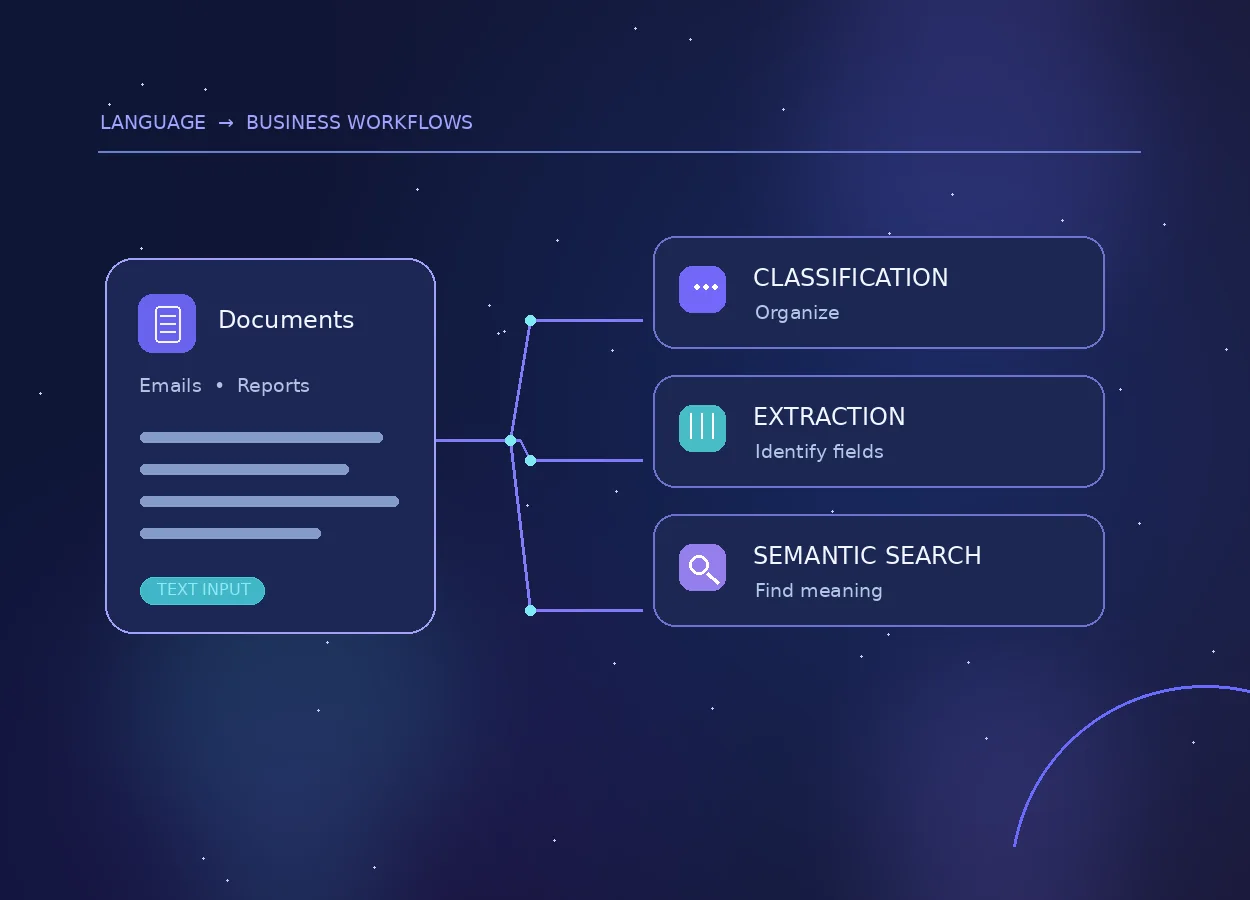
Depending on your requirements, NLP can support document workflows, customer inquiry classification, sentiment analysis, information extraction, and search experiences that understand more than exact keyword matches.
We focus on practical applications that help teams work with language-based information more efficiently and connect relevant insights to existing business processes.
Business Challenges
Businesses may receive hundreds or thousands of text-based records across multiple channels.
Common challenges include:
Manually reviewing emails and support requests.
Extracting information from documents.
Categorizing customer feedback.
Searching large collections of internal information.
Identifying recurring themes in text.
Routing incoming requests to the correct team.
NLP can help automate parts of these processes, subject to language complexity, data quality, accuracy requirements, and appropriate validation.
NLP Development Services
Categorize text into predefined groups to support processes such as request routing, feedback categorization, and document organization.
Identify relevant information in text, such as names, dates, reference numbers, entities, and other fields required by a workflow.
Analyze customer comments and feedback to identify broad sentiment patterns and recurring topics. Results should be evaluated for accuracy and context.
Build search experiences that can identify conceptually relevant information rather than relying only on exact keyword matches.
Use language-processing techniques to support the classification, summarization, and organization of business documents.
Connect text analysis to business rules, notifications, and other workflow actions.
AI and Automation Integration
NLP becomes more useful when the results can support a real operational workflow.
For example, a text classification system may categorize an incoming request and route it to the right team. A document processing workflow may extract selected fields and send them for verification before updating another system.

Potential applications include:
Categorizing customer inquiries.
Organizing incoming documents.
Identifying topics in customer feedback.
Supporting internal knowledge search.
Extracting information for review.
Connecting language analysis to business applications.
We consider the required accuracy, available data, privacy requirements, and appropriate human review before recommending an implementation.
Implementation Process
Understand the text-based workflow and desired outcome.
Evaluate available data, languages, terminology, and accuracy requirements.
Select an appropriate NLP model or service.
Integrate the solution with relevant applications and workflows.
Test representative examples, review errors, and refine the approach.
Frequently Asked Questions
NLP is a field of AI that enables computer systems to process and analyze human language in text or, in related speech applications, spoken language.
NLP can help automate text classification, information extraction, document processing, feedback analysis, and search, depending on the use case.
NLP covers a broad range of language-processing techniques. Generative AI focuses on creating new content, including text. Modern generative models can perform many NLP tasks, but the terms are not interchangeable.
Yes, NLP can support document classification, information extraction, and text analysis. Document layout, image quality, language, and accuracy requirements affect the approach.
NLP solutions can often connect through APIs or custom integrations, depending on the systems and technical requirements.
Natural Language Processing
If your team spends too much time reviewing, sorting, or searching text-based information, let's explore whether NLP can help streamline the process.