
Unclear AI opportunities
Identifying which business processes could benefit from AI.
AI can help businesses work more efficiently, but identifying where it will deliver real value is often the hardest part.
SmartHire Technologies helps businesses evaluate AI opportunities, identify operational bottlenecks, and develop practical strategies for implementing AI where it makes sense. From automating repetitive workflows to integrating AI into existing applications, we help you move from ideas to actionable solutions.
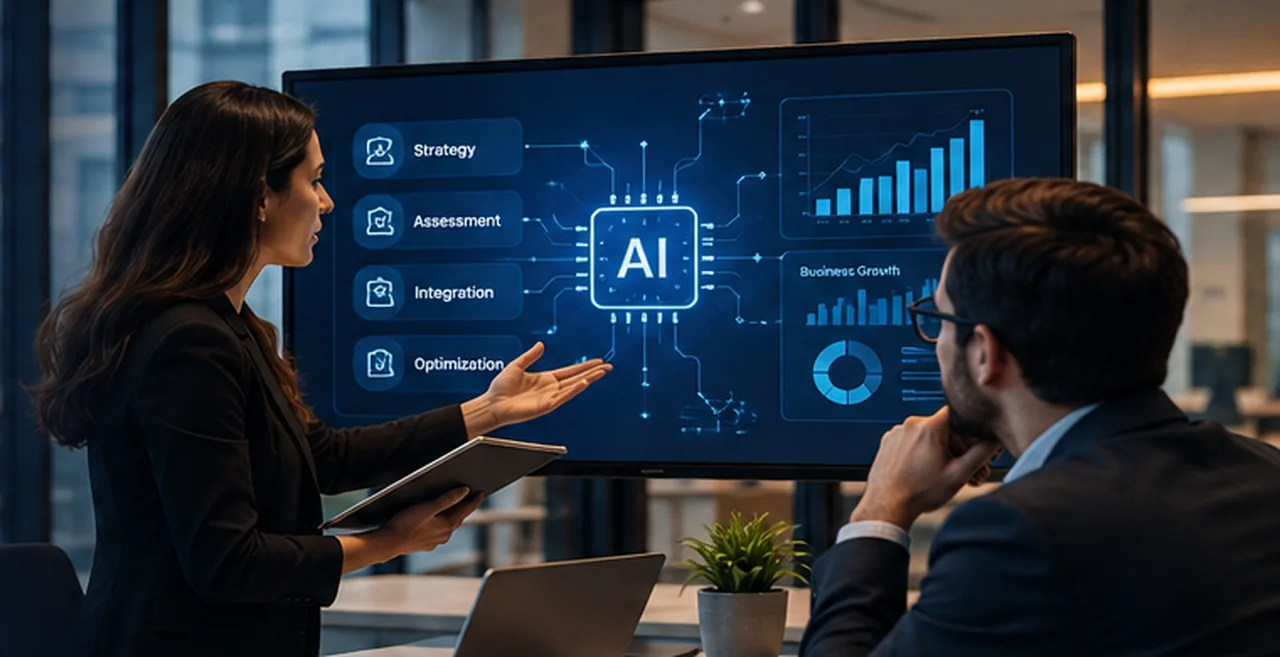
Our approach begins with your business goals—not the technology itself. We look at your current processes, systems, challenges, and priorities to help identify opportunities that can improve productivity, reduce manual effort, and support better decision-making.
Whether you're exploring AI for the first time or looking to improve existing initiatives, we help you determine what to prioritize, how to approach implementation, and what success should look like.
AI adoption can quickly become overwhelming when businesses are faced with new tools, competing technologies, and ambitious promises.
The challenge isn't simply deciding whether to use AI. It's understanding where AI can solve a genuine problem, how it fits into existing workflows, and whether the expected benefits justify the investment.
SmartHire helps businesses address common challenges such as:
Identifying which business processes could benefit from AI.
Finding tasks that may be suitable for automation.
Understanding how AI can work with existing applications and data.
Evaluating the resources, integrations, and ongoing maintenance a solution may require.
Defining measurable objectives before committing to a project.
Considering privacy, access controls, reliability, and appropriate human oversight.
A structured AI strategy helps bring these considerations together so your business can make informed decisions instead of investing in technology without a clear purpose.
Every business has different priorities, systems, and operational challenges. Your AI strategy should reflect those differences.
Our consulting approach focuses on identifying the opportunities that align with your business objectives and determining how to implement them effectively.
Understand whether your business has the processes, systems, data, and resources needed to support a proposed AI initiative.
We can help evaluate your existing technology environment, identify potential constraints, and determine what needs to be addressed before implementation.
Identify workflows where AI may reduce repetitive work, simplify information processing, improve access to business knowledge, or support operational decisions.
The focus is on finding practical opportunities rather than introducing AI simply because it is available.
Not every AI idea deserves the same level of investment.
We help organize potential use cases according to business value, implementation complexity, data requirements, risk, and feasibility. This gives decision-makers a clearer basis for choosing what to explore first.
Turn prioritized opportunities into a practical implementation roadmap.
Depending on your needs, this may include recommended solutions, integration requirements, implementation stages, dependencies, evaluation criteria, and potential future improvements.
Determine how AI capabilities could connect with your existing applications, databases, and workflows.
This may involve evaluating APIs, identifying suitable AI services, and planning how information will move between systems.
Plan for data privacy, security, access controls, human review, and ongoing evaluation.
These considerations are especially important when AI interacts with sensitive information or influences important business decisions.
AI becomes more valuable when it addresses a specific operational challenge.
For some businesses, the opportunity may be automating repetitive document processing. For others, it may involve helping employees find information, categorizing incoming requests, or connecting existing systems so teams spend less time transferring data manually.
SmartHire helps you explore opportunities such as:
We also consider whether a process requires AI at all. Traditional workflow automation, a straightforward integration, or a better web application may sometimes provide a simpler and more cost-effective solution.
The objective is to select the right approach for the problem—not the most complicated technology available.
AI strategy should account for the technology your business already uses.
Depending on the use case, an implementation might involve existing AI services, generative AI models, large language models, workflow automation platforms, APIs, or custom-built applications.
SmartHire can help evaluate the options relevant to your requirements, including:
AI services and models suited to the intended use case.
Integration with existing business applications.
Data availability, quality, and accessibility.
Workflow automation opportunities.
Security and access requirements.
Scalability and ongoing operating costs.
Monitoring and maintenance considerations.
The recommendation should reflect your business requirements, technical environment, budget, and expected outcomes.
When an existing platform can solve the problem effectively, there may be no need to build a completely new system. Custom AI development can be considered when the required functionality cannot be achieved adequately with existing tools.
We begin by learning about your business objectives, current workflows, existing applications, and operational challenges.
This helps establish the context for evaluating AI opportunities.
We identify potential applications of AI and automation based on the problems your business wants to solve.
Each opportunity is considered in terms of expected value, feasibility, data requirements, and implementation effort.
We help organize the options into a practical order of priority.
The goal is to focus on opportunities that offer a reasonable balance of business value, complexity, cost, and risk.
We outline the recommended approach, relevant technologies, integrations, dependencies, and evaluation criteria.
The roadmap can help your team understand what to implement first and how subsequent improvements may fit into the wider strategy.
Define how the success of an AI initiative should be evaluated.
Depending on the project, relevant measures might include processing time, manual intervention, error rates, workflow completion, operating costs, or employee productivity.
This provides a clearer basis for evaluating whether the solution is delivering the intended value.
An effective AI strategy needs to connect business objectives with realistic implementation choices.
SmartHire Technologies approaches AI consulting with a focus on practical opportunities, operational efficiency, and the systems businesses need to make solutions useful.
We begin with your goals and operational challenges, then evaluate which technologies may help address them.
We consider how AI and automation may reduce repetitive work, simplify processes, and improve the use of existing resources.
AI initiatives can be planned alongside web applications, APIs, and business system integrations to support more connected workflows.
Recommendations should translate into clear next steps, with defined priorities and criteria for evaluating progress.
The right approach depends on your existing systems, data, budget, and business needs. We focus on evaluating those factors before recommending a solution.
AI strategy and consulting services help businesses identify suitable AI use cases, evaluate implementation options, prioritize opportunities, and plan how AI can support their business objectives.
AI consulting can identify workflows where AI or automation may reduce repetitive work, simplify information processing, or improve operational efficiency. Actual cost savings depend on the use case, implementation costs, adoption, and ongoing maintenance.
Not every business needs a large-scale AI initiative. However, businesses considering AI investments can benefit from evaluating their objectives, operational needs, available data, costs, and risks before committing to implementation.
Start by identifying repetitive tasks, information-heavy workflows, frequent bottlenecks, and processes that require significant manual effort. Then evaluate whether AI, traditional automation, system integration, or process redesign is the most appropriate solution.
Often, yes. AI capabilities may connect to existing applications through APIs, supported integrations, or custom development. The available options depend on your current systems, access permissions, data requirements, and technical limitations.
An AI roadmap may include prioritized use cases, proposed technologies, integration requirements, implementation stages, risks, estimated effort, and measures for evaluating outcomes. The exact scope depends on the engagement.
Yes. Smaller businesses can use AI consulting to identify focused opportunities, avoid unnecessary technology investments, and prioritize solutions that fit their resources and operational needs.
Consulting and development are related but distinct. Consulting focuses on identifying opportunities and planning solutions. Development involves building or configuring the systems required to implement them. The scope depends on the project and agreed services.
Success measures should reflect the original business objective. Examples include reduced processing time, fewer manual steps, improved workflow completion, lower operating costs, or better access to relevant information.
You don't need to implement AI everywhere to start creating value.
The right first step may be improving a repetitive workflow, connecting disconnected systems, or exploring an AI application that addresses a specific operational challenge.
SmartHire Technologies can help you evaluate your options, prioritize opportunities, and define a practical direction for AI adoption.
Let's discuss your business goals and identify where AI, automation, and integration could make a meaningful difference.