
AI Website Builders vs Professional Web Development: Which Is Right for Your Business?
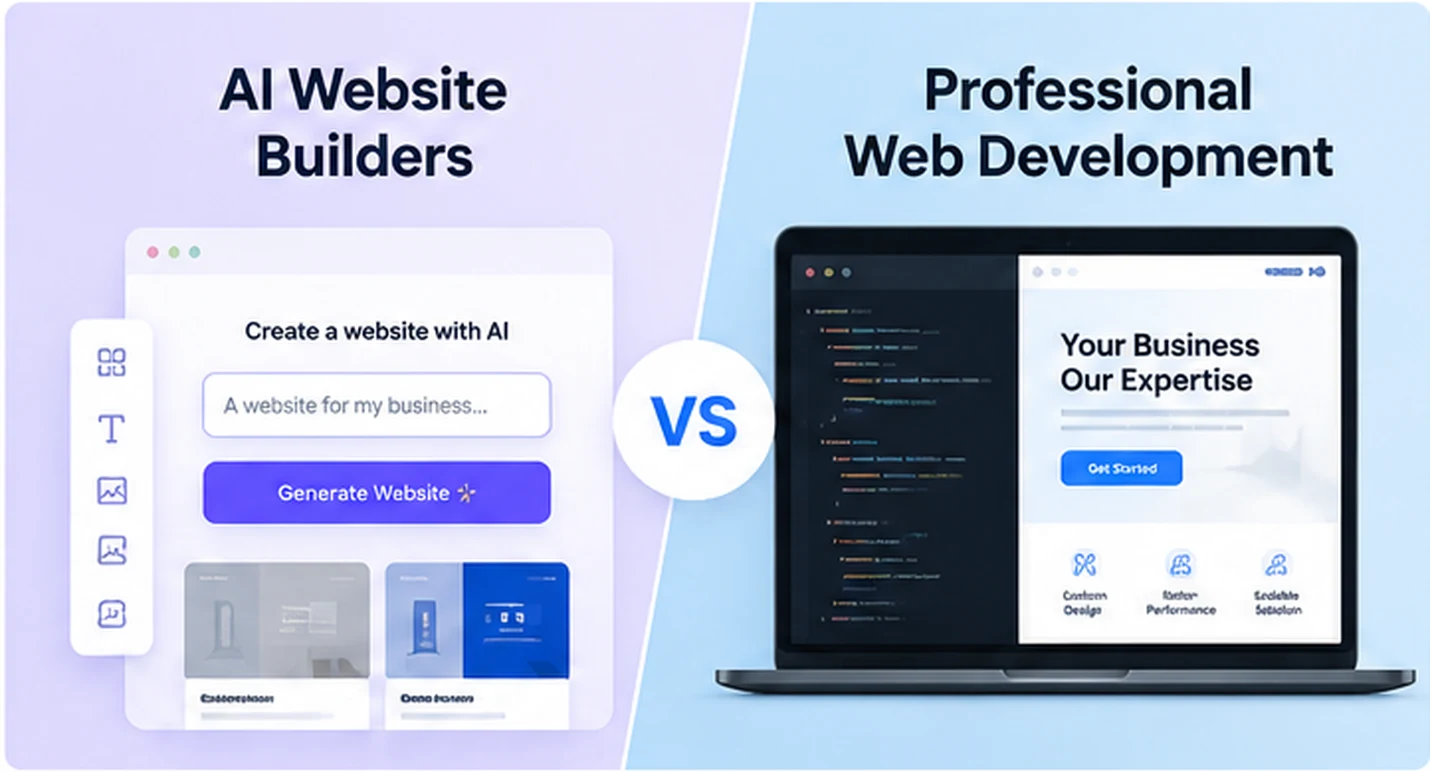
You can build a website today without hiring a developer. AI website builders can create a first draft, suggest page layouts, and help you publish a simple site faster than many traditional methods. But that does not mean they are the right choice for every business.
When comparing AI website builders vs professional web development, start with what your website needs to do. A simple site for a local business may work well with a builder. A business that needs custom booking, account features, payment flows, or connections to other software may need a developer. The best choice is the one that fits your goals, budget, and plans for growth.
AI Website Builders vs Professional Web Development: What Is the Difference?
An AI website builder uses your instructions to help create a website. You might describe your business, choose a style, and provide a few details. The tool then suggests a layout, writes starter copy, or creates page sections you can edit.
These tools can be helpful for getting a first version online. They may also offer hosting, forms, templates, and basic editing tools in one place. The exact features depend on the platform and plan you choose.
Professional web development takes a different approach. A developer or agency learns how your business works, plans the customer journey, chooses the right technology, and builds or configures the website around your needs. That may mean using a website platform, writing custom code, or combining both.
When an AI Website Builder Makes Sense
A builder can be a reasonable choice when your website has a clear and simple purpose. It can help you test a business idea before investing in a larger build.
- You need a small website with a few pages about your services, team, location, and contact details.
- You are testing a new business idea and want to see whether customers respond before spending more.
- Your needs are covered by the builder’s existing forms, booking tools, or online store features.
- You are comfortable editing pages yourself and have time to keep the site updated.
- You understand what the monthly plan includes and what extra apps or features may cost.
For example, a freelance photographer in Austin may need a home page, a portfolio, a pricing page, and a contact form. A builder may cover those needs without a custom build.
When Professional Web Development Is the Better Fit
A website becomes more complex when it needs to support the way your business operates. A polished template cannot solve every business problem.
- You need custom tools, such as a customer portal, quote calculator, service scheduler, or order workflow.
- Your website must connect with a CRM, inventory system, payment provider, or other business software.
- You have many services, locations, products, or types of customers that need a clear path through the site.
- Your current site is hard to use, slow, difficult to update, or failing to turn visits into leads.
- You need a clear plan for content ownership, data access, testing, security updates, backups, and support.
Consider a roofing company serving Tampa and nearby Florida communities. A simple builder site may work at first. If the company later wants estimate requests routed by ZIP code, job photos attached to forms, leads sent to a CRM, and different pages for roof repair and replacement, it should check whether the existing platform can handle those needs reliably. A developer may be able to configure the platform or build the missing parts.
Compare the Total Cost, Not Just the Starting Price
AI website builders often have a lower starting cost. However, the monthly plan is only one part of the price. You may also pay for apps, advanced features, payment processing, extra storage, or help when something stops working.
Professional development usually costs more upfront because planning, design, development, testing, and launch work take time. The value depends on what you receive and how well the website serves the business after launch.
Before comparing quotes, list the features you need now and the ones you expect to need within the next year. Ask what is included, who maintains the site, how changes are priced, and what happens if you leave the platform or change providers.
Seven Questions to Ask Before You Choose
1. Can I move my domain, content, customer data, and product information if I change platforms? Ask what can actually be exported.
2. Can the website connect to the tools my team already uses, such as a CRM, scheduling app, or inventory system?
3. Can I edit common content myself without needing a developer for every small change?
4. Can I set page titles, descriptions, redirects, internal links, and other basic SEO details? Google’s SEO Starter Guide explains the basics.
5. Does the site work well on phones, load quickly, and make it easy to contact the business?
6. How are security updates, backups, bug fixes, and support handled?
7. Can I measure calls, form submissions, bookings, and sales accurately?
A Good-Looking Website Is Not Always a Good Business Website
A website can look modern and still make it hard for customers to take the next step. Visitors need to understand what you offer, who you help, why they should trust you, and how to contact you.
Before launch, test the site on a phone. Ask someone who has never seen it to find a service, understand the offer, and send an inquiry. Check that forms work, links go to the right pages, and important details are easy to find. Use reliable guidance such as web.dev’s Core Web Vitals overview to understand common page performance checks, and consult the W3C accessibility guidelines when reviewing accessibility.
You Can Also Take a Hybrid Approach
It does not have to be AI builder or custom code. A business can use a website platform and still hire a professional to plan the pages, improve the design, set up analytics, fix technical issues, or connect the site to other tools.
This approach can work well when you want to keep control of everyday edits but need expert help with the parts that affect leads, search visibility, or operations. Make sure the platform can support your plans before you invest too much in it.
Frequently Asked Questions
Can an AI-built website rank on Google?
Yes, a website made with an AI builder can appear in Google Search. Rankings depend on many factors, including useful content, technical access, relevance, and competition. The builder alone does not guarantee rankings.
Will I need a developer later?
Not always. Some businesses can use a builder for years. Others need a developer when they add new features, connect business systems, or improve a site that no longer meets customer needs.
How do I know whether to redesign my website?
Start by identifying the problem. If the content is clear but a form is broken, a full redesign may not be needed. If customers cannot find services, the site does not work well on mobile, or the business has changed, a broader redesign may make sense.
Choose the Website That Fits Your Business
The right website is not the one with the most features. It is the one that helps customers understand your offer and take the next step, while giving your team a site it can manage.
SmartHire Technologies helps US businesses plan, build, and improve websites around their goals. If your current site feels limited or does not bring in the inquiries you expect, request a website review and discuss what should be fixed first.
Interested in learning more about our solutions? Read about our Web Development services.
Choose the Website That Fits Your Business
Request a website review